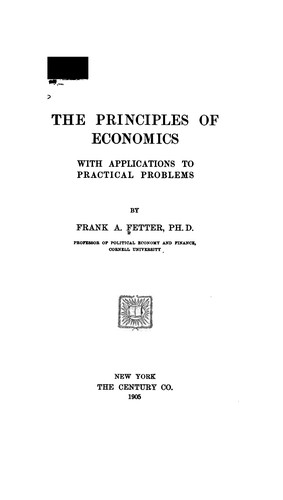
Código QR con enlace a esta página Principles of Economics with Applications to Practical Problems por Frank Albert Fetter
Precio: 0,00 US$ Proveedor: Librivox Idiomas: Géneros: Business & Economics / General
Valoración: Frank Albert Fetter was an American economist of the Austrian school, but referred to himself as a member of the “American Psychological School” instead. Fetter contested the position that land is theoretically distinct from capital, arguing that such a distinction was impractical. His stand on this issue led him to oppose ideas like the land value tax.
Fetter also asserted that just as the price of each consumer good is determined solely by subjective value, so the rate of interest is determined solely by time preference. He maintained that time valuation was prerequisite to the determination of the market rate of interest, and he emphasized the time valuation element in all consumption and production choices. Fetter taught at Cornell University, Indiana University, and Stanford University. He was the first chairman of Princeton University's Department of Economics and Social Institutions, an interdisciplinary department that incorporated history, politics, and economics. (Summary by Wikipedia)
Capítulos Previous 02 01 - Chapter 1 - The Nature and Purpose of Political Economy
03 02 - Chapter 2 - Economic Motives
04 03 - Chapter 3 - Wealth and Welfare
05 04 - Chapter 4 - The Nature of Demand
06 05 - Chapter 5 - Exchange in a Market
07 06 - Chapter 6 - Psychic Income
08 07 - Chapter 7 - Wealth and Its Direct Uses
09 08 - Chapter 8 - The Renting Contract
10 09 - Chapter 9 - The Law of Diminishing Returns
11 10 - Chapter 10 - The Theory of Rent
12 11 - Chapter 11 - Repair, Depreciation, and Destruction of Wealth
13 12 - Chapter 12 - Increase of Rent-Bearers and of Rents
14 13 - Chapter 13 - Money as a Tool in Exchange
15 14 - Chapter 14 - The Money Economy and the Concept of Capital
16 15 - Chapter 15 - The Capitalization of All Forms of Rent
17 16 - Chapter 16 - Interest on Money Loans
18 17 - Chapter 17 - The Theory of Time-Value
19 18 - Chapter 18 - Relatively Fixed and Relatively Increasable Forms of Capital
20 19 - Chapter 19 - Saving and Production as Affected by the Rate of Interest
21 20 - Chapter 20 - Labor and Classes of Laborers
22 21 - Chapter 21 - The Supply of Labor
23 22 - Chapter 22 - Conditions for Efficient Labor
24 23 - Chapter 23 - The Law of Wages
25 24 - Chapter 24 - The Relation of Labor to Value
26 25 - Chapter 25 - The Wage System and Its Results
27 26 - Chapter 26 - Machinery and Labor
28 27 - Chapter 27 - Trade-Unions
29 28 - Chapter 28 - Production and the Combination of the Factors
30 29 - Chapter 29 - Business Organization and the Enterpriser's Function
31 30 - Chapter 30 - Cost of Production
32 31 - Chapter 31 - The Law of Profits
33 32 - Chapter 32 - Profit-Sharing, Producers' and Consumers' Cooperation
34 33 - Chapter 33 - Monopoly Profits
35 34 - Chapter 34 - Growth of Trusts and Combinations in the United States
36 35 - Chapter 35 - Effect of Trusts on Prices
37 36 - Chapter 36 - Gambling, Speculation, and Promoters' Profits
38 37 - Chapter 37 - Crises and Industrial Depressions
39 38 - Chapter 38 - Private Property and Inheritance
40 39 - Chapter 39 - Income and Social Service
41 40 - Chapter 40 - Waste and Luxury
42 41 - Chapter 41 - Reaction of Consumption on Production
43 42 - Chapter 42 - Distribution of the Social Income
44 43 - Chapter 43 - Survey of the Theory of Value
45 44 - Chapter 44 - Free Competition and State Action
46 45 - Chapter 45 - Use, Coinage, and Value of Money
47 46 - Chapter 46 - Token Coinage and Government Paper Money
48 47 - Chapter 47 - The Standard of Deferred Payments
49 48 - Chapter 48 - Banking and Credit
50 49 - Chapter 49 - Taxation in its Relation to Value
51 50 - Chapter 50 - The General Theory of International Trade
52 51 - Chapter 51 - The Protective Tariff
53 52 - Chapter 52 - Other Protective Social and Labor Legislation
54 53 - Chapter 53 - Public Ownership of Industry
55 54 - Chapter 54 - Railroads and Industry
56 55 - Chapter 55 - The Public Nature of Railroads
57 56 - Chapter 56 - Public Policy as to Control of Industry
58 57 - Chapter 57 - Future Trend of Values
Next A la gente también le gustó
Reseñas Inicia sesión para escribir una reseña
Iniciar sesión